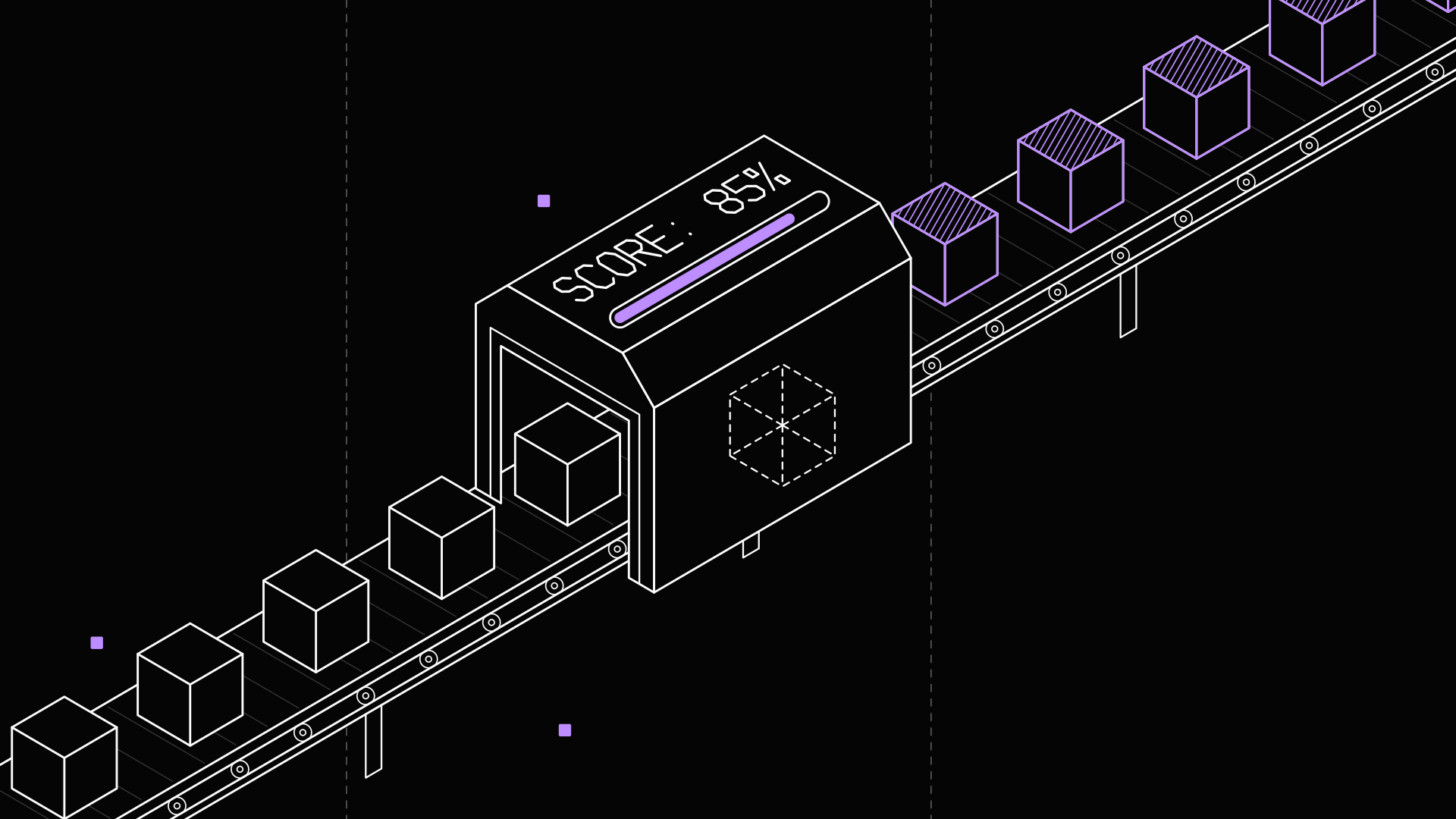
Agent confidence is an estimate, made before any code is written, of how likely an AI agent is to complete a ticket correctly without human help. A ticket is ready for an agent when the agent can tell what to change, where to change it, and how to prove the change works.
Most failed agent runs were decided before the agent started. The ticket left out a decision, pointed at a document the agent could not open, or described a change nobody could test. Scoring confidence first finds those tickets while fixing them is still cheap.
What is an agent confidence score?
It is a number attached to a ticket during triage. In Clears, every ticket gets a score from 0 to 100%, grouped into High, Medium or Low, along with the reasoning behind it. High-confidence tickets are ready to run from start to finish. Low-confidence tickets are flagged for a person, or for splitting into smaller pieces, before any work is spent on them.
The reasoning matters more than the number. "Low: the ticket does not say what should happen to existing records" tells the author exactly what to add.
How is confidence different from risk and complexity?
They answer three separate questions, and a ticket can score differently on each.
| Score | The question it answers | What drives it |
|---|---|---|
| Confidence | Can an agent get this right on its own? | How clear the requirement is, whether the needed context is available, whether the result can be verified |
| Risk | How bad is it if this goes wrong? | Blast radius, data sensitivity, architectural impact |
| Complexity | How much work is this? | Dependencies across services, unknowns, scope |
A one-line change can be low confidence if nobody said which line. A large migration can be high confidence if it repeats a known pattern and has tests. And a high-confidence ticket can still be high risk, in which case you run it and review it more carefully.
What makes a ticket low confidence?
Almost always one of three things:
- Ambiguity. The ticket does not say what done looks like. Typical gaps are an API contract that is not specified, a data change with no word on existing records, or a screen with no description of its empty and error states.
- Missing context. The ticket depends on something the agent cannot open: an attachment, a design file, a document in a shared drive, or a decision made in a chat thread.
- No way to verify. No tests cover the area, CI does not exercise it, or the behaviour only shows up in an environment or on hardware the agent cannot reach.
How do you raise a ticket's confidence?
Each blocker has a direct fix, and most take a few minutes.
| Blocker | Fix |
|---|---|
| "Done" is not defined | Add acceptance criteria: inputs, expected results, edge cases |
| A decision is still open | Answer the triage question once, in the ticket, so the answer stays with it |
| A linked resource cannot be opened | Connect that source, or paste the relevant part into the ticket |
| It is unclear where the change goes | Name the service, or confirm the repositories triage identified |
| Nothing to verify against | Point to a test, add one, or describe how you would check the change by hand |
| The ticket is too big | Split it into stories that each have one outcome you can verify |
What should you do with each confidence band?
- High. Run it. Review the pull request when it arrives.
- Medium. Answer the open questions, then run it.
- Low. Do not run it yet. Fix the ticket, split it, or leave it with a person.
Why score before any code is written?
Because that is the cheapest moment to find a problem. A run that fails costs compute, a reviewer's time, and some of the team's trust in the tool. A question answered at triage costs a minute.
Scoring also changes the question leaders ask. "Is AI working for us?" becomes "how much of our backlog is ready for agents, and what is blocking the rest?" The second question has an answer you can act on.
In Clears, this happens on the Triage & Intake step, for every ticket that comes in.